Wednesday at 2 PM (UTC +1)

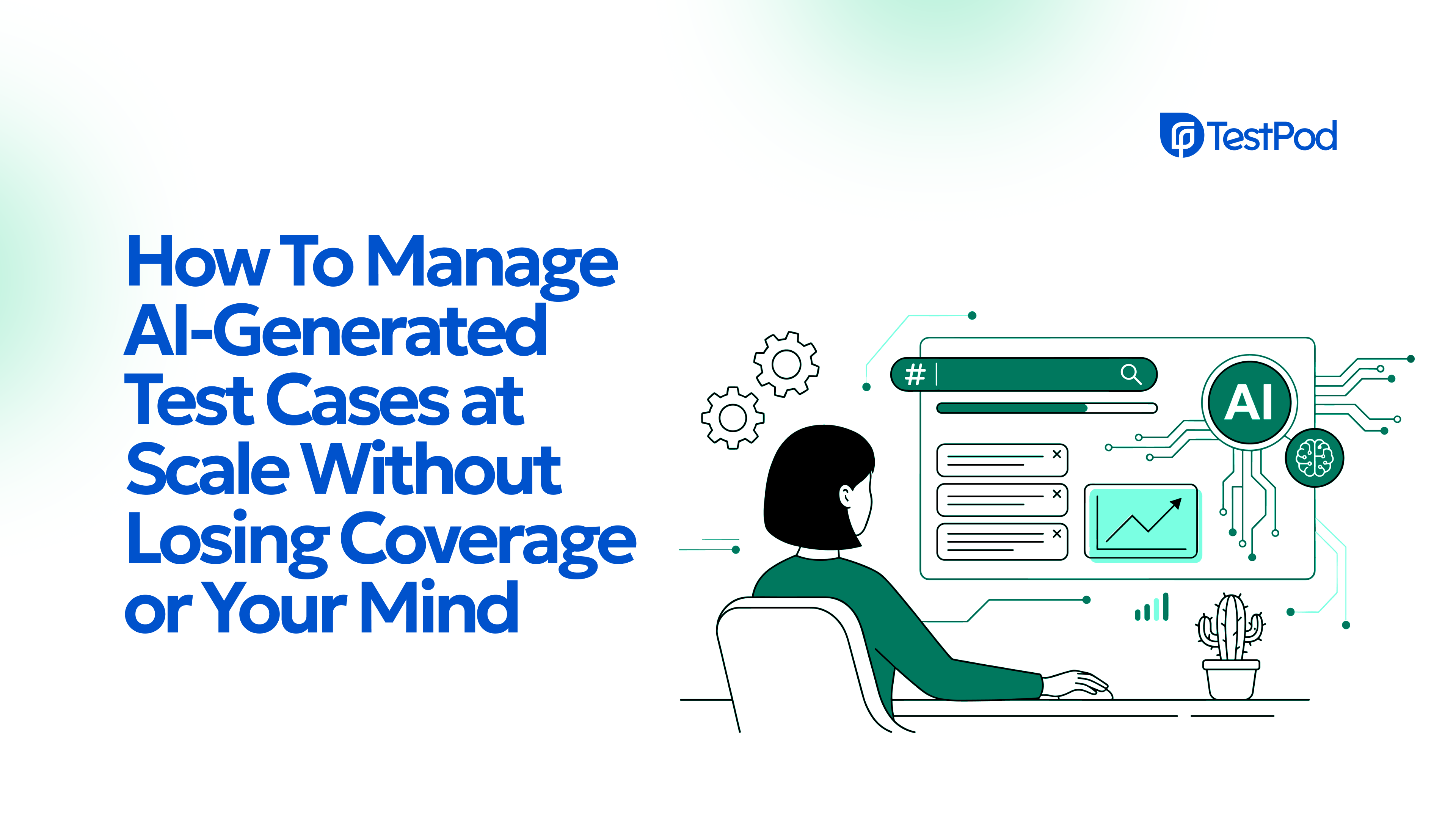
AI has changed the pace of software testing. What used to take days, writing, structuring, and maintaining test cases, can now happen in minutes. With AI-powered tools generating tests from requirements, user stories, or even live applications, teams are shipping faster than ever.
But there’s a catch.
As the volume of AI-generated test cases grows, many teams run into a new kind of problem: too many tests, not enough clarity. Coverage becomes unclear, duplication creeps in, maintenance becomes chaotic, and suddenly, the system meant to simplify testing starts creating noise.
This is where most teams struggle, not with generating tests, but with managing them at scale.
Let’s break down how to handle AI-generated test cases effectively without losing coverage or your sanity.
The Real Problem Isn’t Generation, It’s Management
AI can generate thousands of test cases across flows, edge cases, and variations. On paper, that sounds like perfect coverage.
In reality, it often leads to:
- Redundant or overlapping test cases
- Poorly structured test suites
- Difficulty tracking what’s actually covered
- Increased execution time with little added value
- Confusion across teams on what matters
The issue isn’t that AI is doing too much; it’s that there’s no system governing what it produces.
Without proper test management, scale becomes a liability.
Why Traditional Test Management Breaks at Scale
Most legacy approaches to test management weren’t built for AI-driven workflows.
They assume:
- Tests are written manually
- Test suites grow gradually
- Humans control the structure and organisation
AI breaks all of that.
Instead of dozens of tests, you now have hundreds or thousands generated instantly. Without automation in organisation, prioritisation, and visibility, the system collapses under its own weight.
Managing AI-generated tests requires a shift from static management to dynamic, intelligent test orchestration.
1. Start With Clear Test Objectives (Before Generation)
One of the biggest mistakes teams make is letting AI generate tests without constraints.
AI is powerful, but it needs direction.
Before generating tests, define:
- What flows matter most (critical user journeys)
- What level of coverage you need (functional, edge cases, regression)
- What environments or platforms to prioritise
When you guide generation with intent, you reduce unnecessary noise and keep your test suite aligned with real product goals.
2. Organise Tests by Intent, Not Just Features
Traditional test organisation often mirrors product structure: pages, modules, or components.
That doesn’t work well with AI-generated tests.
Instead, organise tests based on intent and risk, such as:
- Core user journeys (e.g., signup, checkout, onboarding)
- Edge cases and failure scenarios
- Regression-critical paths
- Platform-specific behaviors
This approach makes it easier to:
- Understand what each test is validating
- Identify gaps in coverage
- Prioritise execution
It also prevents your test suite from becoming a flat, unreadable list of cases.
3. Deduplicate Aggressively
AI doesn’t always know when it’s repeating itself.
Different prompts or inputs can lead to highly similar test cases. At scale, this results in bloated suites that slow down execution without improving coverage.
You need a system to:
- Identify overlapping scenarios
- Merge similar test cases
- Eliminate low-value duplicates
Deduplication isn’t just cleanup; it’s essential for maintaining signal over noise.
4. Prioritise What Actually Matters
Not all tests are equal.
When AI generates tests at scale, it’s tempting to run everything. But doing so wastes time and resources, especially in CI/CD pipelines.
Instead, introduce intelligent prioritisation:
- Run critical path tests first
- Tag high-risk scenarios for frequent execution
- Defer low-impact tests to scheduled runs
This ensures your team gets fast feedback where it matters most, without being overwhelmed by volume.
5. Maintain Visibility Into Coverage
Here’s where many teams lose control.
They have thousands of tests, but can’t confidently answer:
- What features are fully covered?
- Where are the gaps?
- Which tests map to which requirements?
Managing AI-generated tests requires clear visibility layers, such as:
- Mapping tests to user stories or requirements
- Coverage dashboards that show tested vs untested areas
- Traceability between tests, bugs, and releases
Without this, you’re not testing, you’re just running scripts.
6. Automate Test Maintenance
AI-generated tests are dynamic—but your application is even more dynamic.
As your product evolves:
- UI changes
- APIs update
- Workflows shift
If your tests don’t adapt, they quickly become outdated.
Manual maintenance at scale is impossible. You need:
- Self-healing mechanisms
- Smart locators and adaptive logic
- Automated updates based on changes
This is where AI should work for you, not against you, by reducing maintenance overhead instead of increasing it.
7. Align Test Management With Your Automation Strategy
Test automation and test management can’t operate in silos anymore.
When AI is generating and executing tests, management must be tightly integrated into that workflow.
This means:
- Real-time syncing between test execution and test management
- Unified reporting across teams
- Shared visibility between QA, developers, and product teams
Without alignment, you end up with disconnected systems and disconnected insights.
8. Enable Collaboration Across Teams
AI-generated testing isn’t just a QA activity anymore.
Product managers, developers, and even non-technical stakeholders can now contribute to testing by defining goals, reviewing outputs, or analysing results.
Your test management system should support:
- Easy collaboration and sharing
- Clear reporting that non-QA stakeholders understand
- Centralised access to test insights
The more accessible your testing process is, the more effective it becomes.
How TestPod Helps You Manage AI-Generated Tests at Scale
Managing AI-generated test cases requires more than just storage; it requires intelligence, structure, and visibility.
This is where TestPod comes in.
As an AI-powered test management platform, TestPod is designed for modern testing workflows where automation and AI play a central role.
With TestPod, teams can:
- Organise large volumes of test cases into structured, meaningful suites
- Maintain clear traceability between tests, requirements, and outcomes
- Gain real-time visibility into coverage and test performance
- Collaborate seamlessly across QA, engineering, and product teams
- Reduce noise through better test organisation and reporting
Instead of drowning in test cases, teams can focus on what truly matters: delivering quality software with confidence.
Conclusion
AI-generated test cases are a game changer, but only if they’re managed properly.
Without structure, visibility, and prioritisation, scale becomes chaos. But with the right approach, it becomes a competitive advantage.
The goal isn’t to generate more tests.
The goal is to manage them intelligently.
Because in modern QA, success isn’t measured by how many tests you have, it’s measured by how well you understand and use them.